
USD vs glTF: Advantages for 3D Asset Interchange
Explore the advantages of USD versus glTF for 3D asset interchange and when to use each format in your production pipeline.
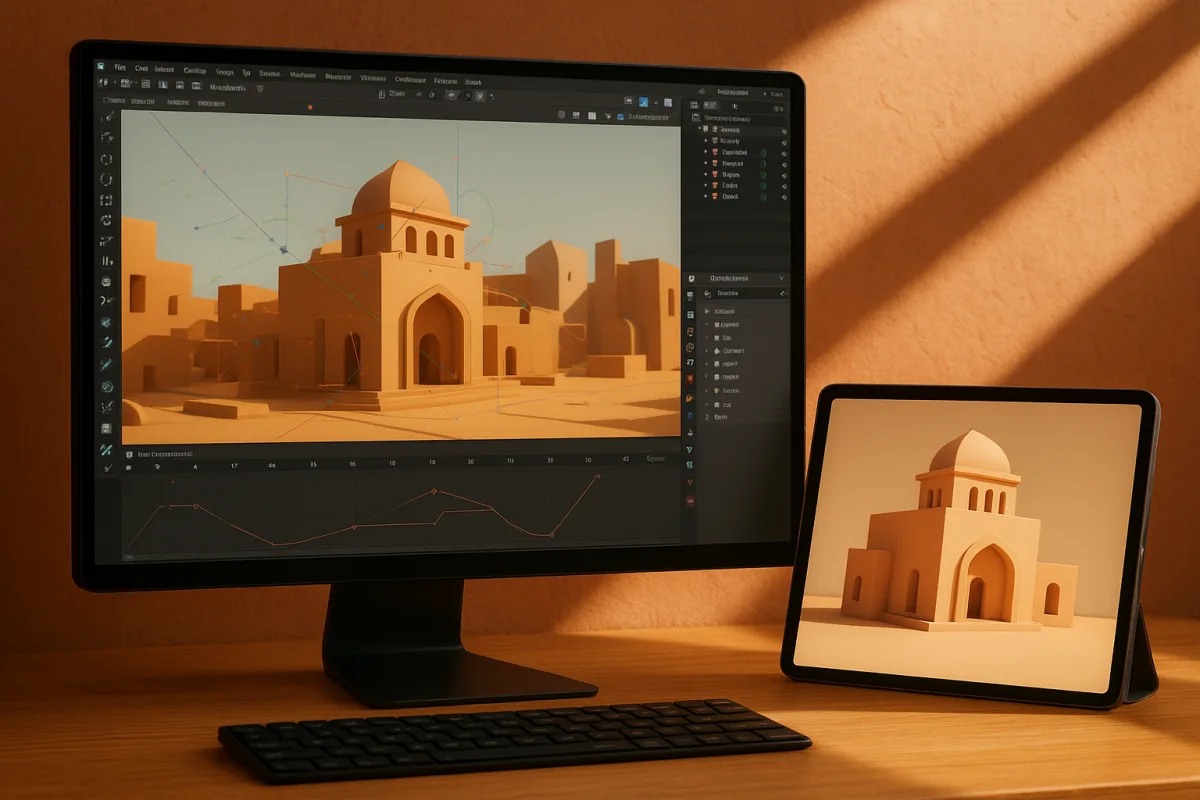
The file on your desk: a finished package or a living scene?
A GLB arrives as one portable file: mesh, textures, materials, cameras, and animation can travel together. It is built to be handed to a viewer, a web page, or a real-time application and opened quickly. [3]
A USD scene is built around a different promise. Its strength is not the smallest possible handoff file, but the ability to assemble a shot or world from many contributing files while preserving who authored what. [1][13]
That is the core distinction pipeline managers need to organize around. glTF packages an asset for consumption, while USD composes a scene whose parts may continue changing throughout production.
Neither description makes one format universally superior. USD files can be larger and slower to load than glTF equivalents, while glTF’s compact transmission and loading behavior can outweigh sophisticated scene controls for web and real-time work. [3][5]
We would begin by mapping where the asset stops changing. If it remains a shared production object, reach for USD. If it has reached approval and must travel reliably to many runtime destinations, publish glTF.
USD’s advantage: composition without destructive handoffs
USD, Universal Scene Description, was designed to describe complex scenes through composition. A scene can reference other assets and organize them into hierarchies, letting a production build a larger whole without merging every model into one master file. [1][2]
Think of a film shot containing a character, costume, prop set, lighting setup, and set dressing. Each department can contribute a separate layer, and the composed stage presents their combined result. [1][13]
Layers are USD’s central production mechanism. A stronger layer can override an opinion from a weaker layer, so a lighting department can adjust a material relationship or visibility state without editing the original asset author’s file. [13]
This is non-destructive because the base asset remains intact. The override exists as its own authored opinion, which can be removed, replaced, or reordered without manually restoring an earlier version of the scene. [1][13]
For a pipeline manager, that changes responsibility. Modeling owns a model layer, look development can own material or shading overrides, layout can own placement, and shot work can add its own specific changes.
The result is traceability through structure, not through a stack of duplicate exports named final, final_02, and final_really_final. USD’s composition system is intended to let departments contribute without flattening those boundaries. [1][13]
USD also supports variants, alternate configurations within the same scene description. A vehicle can carry different trim, color, or damage states, and a production can select the needed state without maintaining unrelated copies of the entire asset. [1][2]
Variants are especially valuable when a change affects several departments. A costume version may require different geometry, textures, and simulation inputs, but its alternatives can remain organized as one configurable production asset. [1][2]
This is why USD appears in complex collaborative workflows associated with film, VFX, and Nvidia Omniverse pipelines. Its scene graph, composition arcs, layers, and variants address the problem of many people changing connected work. [1][2][15]
Milk VFX’s work on the television production Surviving Earth used Houdini and Unreal Engine in a VFX workflow, illustrating the kind of multi-application environment where scene interchange and structured pipeline data become central concerns. [4]
USD’s OpenUSD Core Specification 1.0 was ratified in December 2025, formalizing the core specification while further enhancements remain planned. [1] For a manager, formalization reduces ambiguity around the foundation, not the work of implementing it across tools.
What USD costs you
Composition carries overhead. A USD pipeline asks artists and technical directors to understand layers, references, variants, asset paths, and the order in which authored opinions resolve. [1][13]
That learning cost is real because the format permits powerful behavior that is not obvious from a viewport. A missing texture, unexpected material, or wrong variant may be caused by composition rules, not by corrupt geometry.
Asset naming and storage become pipeline concerns, too. References only work when the receiving application can resolve the linked files, so a scene’s portability depends on managed paths and available dependencies. [1]
USD can also be a poor fit for a simple endpoint. If a marketing team needs one interactive product viewer, a layered scene with many external assets may add loading and deployment complexity where a compact GLB would be easier to distribute. [3][5]
No published benchmark in the available material provides typical file-size or loading-time figures for comparable film and game assets. Do not build a format policy around invented percentage savings or assumed load-time multipliers.
The absence of licensing fees does not erase adoption cost. Both USD and glTF are open standards, but integration, training, validation, exporter settings, and changing established artist habits still consume budget and production time. [1][6]
We would not mandate USD because a studio is large, nor glTF because a team is small. The available evidence supports application needs and existing infrastructure as the deciding factors, not company size or region alone.
glTF’s advantage: an approved asset that travels cleanly
glTF, the Graphics Language Transmission Format, focuses on efficient delivery of 3D scenes and models. Its binary GLB form can place the asset’s data into one file, making it convenient to transmit and deploy. [3]
A GLB is a strong answer to a familiar handoff problem: someone receives geometry, image maps, and materials in mismatched folders, then discovers a viewer cannot find the texture path. The package keeps those components together. [3]
glTF is optimized for web, AR, VR, and real-time applications, where startup time, download size, and broad runtime compatibility affect the experience directly. [5][7] That orientation makes it a delivery format, not a miniature VFX scene database.
Its physically based rendering material model helps a base color, metallic, roughness, normal, and related material description transfer consistently between supporting real-time platforms. [5][7] It cannot guarantee identical pixels across different renderers, but it establishes a shared PBR language.
For artists, this is a look-development advantage with limits. A carefully authored real-time material can arrive in another supporting runtime with its core PBR intent intact, avoiding a complete rebuild for common asset types. [5][7]
Land of Assets, a 3D asset marketplace, says it standardized on glTF for distribution because the format supports broad compatibility and efficient asset delivery. [9] That is the same problem many catalog, configurator, and product-visualization teams need to solve.
Dassault Systèmes also positions glTF for e-commerce use, where interactive 3D product presentation needs to reach customers efficiently. [11] A browser-facing chair, appliance, or scanned object benefits more from predictable delivery than from deep layer composition.
glTF 2.1 adds referencing and external assets for more complex scenes. [6] This gives the format some scene-assembly capability, but it does not provide USD’s established layering and non-destructive composition workflow. [6][13]
That limit is healthy to state plainly. glTF can represent a scene and now address more complex arrangements, but it does not replace the workflow of departments authoring layered opinions over a shared production stage.
What glTF costs you
glTF’s simplicity is an advantage only when your asset is ready to be packaged. It has no native USD-style layering system for retaining multiple non-destructive departmental edits within the asset exchange process. [6][13]
That means revisions can become export events. If the sculpt changes in ZBrush, the materials change in Substance Painter, and the final delivery is a GLB, someone must manage those updates and republish the approved package.
For a single asset catalog, that can be exactly right. For a shot with continually changing layouts, character versions, set assets, and lighting overrides, repeated package exports can obscure ownership and make review harder.
A GLB may also encourage teams to confuse runtime appearance with source ownership. It can be excellent for delivering approved geometry and PBR materials, while being a poor master record for all the editable decisions behind them. [3][5]
We would keep source files and the working look-development process separate from the published GLB. The GLB is the artifact a customer, viewer, or engine receives, not necessarily the place where artists should perform every iteration.
Blender and the toolchain reality
In Blender 5.2 LTS, glTF import and export are the more mature interchange path. That makes glTF the lower-friction option for teams handing assets from Blender into web, AR, VR, and real-time workflows. [14]
Blender’s USD support is developing, including work identified for Blender 5.3 alpha such as Collection Importer and Gaussian Splat import. [14] Treat an alpha feature as a reason to test a workflow, not as a reason to promise production parity.
The exact current USD and glTF support situation for Houdini and Substance Painter is not established in the available material. Do not assume that a format supported by Blender will preserve the same data, controls, or behavior in every application.
The same caution applies to ZBrush, Marmoset Toolbag, Plasticity, and Nomad Sculpt workflows. glTF may be attractive for lightweight interchange because of its broad adoption and straightforward delivery model, but each handoff needs an actual round-trip test.
A round-trip test should follow one asset through the work you need preserved: geometry, transforms, UVs, texture assignments, material intent, cameras, animation, and any required metadata. Do not declare a standard after testing only a static cube.
For USD, test layer overrides, asset references, variants, and path resolution. For glTF, test the final GLB in the actual browser, engine, AR viewer, or real-time runtime that will display it.
Build a two-format policy when the work demands it
A mature pipeline often needs both roles. USD can hold the living production scene, while glTF becomes the published derivative for a web viewer, product configurator, real-time review tool, or portable client handoff.
This division gives each format work suited to its design. USD retains assembly, revisions, and ownership; glTF carries a compact approved result to the systems that value loading speed and dependable PBR delivery. [1][3][5]
We would define the conversion point in writing. For example, geometry and approved textures may move into a glTF publishing step only after modeling and look development reach a named review state.
Then define what cannot survive the handoff. USD layers, variants, and production-specific composition behavior need explicit treatment, while a GLB recipient should expect a delivery asset, not the full editable history behind it. [6][13]
The winning standard is the one that preserves the information your next person needs. If that person is a lighter assembling a changing shot, USD earns its overhead. If that person is a browser loading a finished model, glTF earns its place.
Frequently Asked Questions
What are the advantages of USD compared to glTF for 3D asset interchange?
USD supports complex scene composition through layering, variants, and non-destructive overrides, allowing multiple departments to contribute and modify parts of a scene without permanently altering the base assets. It enables traceability and collaborative workflows by preserving who authored what and managing alternate configurations within a single scene description. In contrast, glTF focuses on compact, efficient delivery rather than production flexibility.
When should I use USD instead of glTF in a 3D production pipeline?
USD is best used when a scene or asset remains a shared, evolving object that requires contributions and overrides from multiple departments throughout production. It is ideal for complex workflows where non-destructive editing and scene assembly from many files are needed. Once the asset is finalized and approved for distribution, glTF is preferable for lightweight, real-time, or web-based delivery.
How does USD support collaborative workflows better than glTF?
USD’s layering system allows different teams to own separate layers that can override each other without modifying the original files, enabling non-destructive edits and easy rollback. Variants within USD let productions manage alternate configurations of an asset without duplicating entire files. This structure supports multiple contributors working simultaneously while maintaining clear authorship and version control.
Why is glTF preferred for real-time and web applications over USD?
glTF packages all necessary data into a single, compact file optimized for fast loading and efficient transmission, making it well suited for browsers, AR experiences, and real-time viewers. Its lightweight nature and consistent PBR material support facilitate reliable rendering in interactive environments where performance and quick asset delivery are priorities.
Can USD and glTF be used together in a 3D asset pipeline?
Yes, USD can be used as the working format during production to manage complex, collaborative scene assembly, while glTF serves as the delivery format for approved assets that need to load quickly in runtime applications. This approach leverages USD’s strengths in authoring and glTF’s efficiency in distribution.
How we researched this
This article was assembled from 15 cited references.
Nothing here is based on hands-on testing. Where a figure or finding appears, it belongs to the source cited beside it, and the writing says so rather than implying otherwise. Every source is listed below so you can check it.
Sources
- Introduction to USD, Universal Scene Description 27.02 documentation
- Universal Scene Description (USD): The Format Behind Modern 3D Pipelines | Immersion 3D
- GLB vs GLTF: What's the Difference? | GLBKit
- How Unreal Engine and Houdini power the VFX of Surviving Earth
- USD vs glTF for AR Asset Interchange | In-Depth Comparison | Inference Systems
- Introducing glTF 2.1 with Complex Scenes
- glTF: Conversion, Compatibility & Optimization | CAD Interop
- 3D Asset
- Blog - Why Land of Assets Standardizes on glTF | Land of Assets
- OBJ vs GLTF, Which 3D Format Should You Use? | GeometryViewer
- New Dimension of e-Commerce with glTF | Dassault Systèmes
- Transforming 3D Design: The Role Of GlTF Asset Interchange - Bytecs IT Solutions
- Layers, Learn OpenUSD
- Pipeline & I/O - Blender Developer Documentation
- glTF Assets in Nvidia Omniverse USD Pipelines - gltf
Related Articles
Export Assets from Modo to Houdini for Simulation
Learn how to export assets from Modo to Houdini for simulation, including file formats, scale setup, and mesh preparation tips.

Difference Between Normal Maps and Displacement Maps
Learn the difference between normal maps and displacement maps and when to use each for 3D modeling and rendering.
Complete Beginner Blender Project Workflow Explained
Learn the complete beginner Blender project workflow from modeling to rendering with the donut tutorial and course length tips.
Sculpting Software for Character Creation: Blender vs ZBrush
Compare sculpting software for character creation and learn when to choose Blender or ZBrush for your 3D sculpting needs.